| Phone |
| |
| |
| 대표전화 |
1577-7956 |
| 본 사 |
031-457-9187 |
| 대 전 |
042-932-1265 |
| |
|
| Web Site Visitors |
| |
| |
| Today |
1269 |
| Yesterday |
1645 |
| Since 2006 |
2,731,933 |
| |
|
|
|
 |
|
|
(curcumin nanoemulsion 에 대한 식물성 유화제인 pectin 과 gum Arabic 의 안정성 효과 분석) |
|
Ilyes Dammak, Paulo Jos´e & Amaral Sobral (2021). Elsevier Ltd., 2212-4292. |
| | 원문보기
| 리스트돌아가기 | |
Introduction
pectin 과 gum Arabic 을 유화제로 사용하는 curcumin (강황) nanoemulsion 에서 pectin 과 gumArabic 유화제가 외부의 다양한 환경에 대해
어느정도 stability 를 유지하는지 확인하기 위해 신속하고 정밀한 분산안정성 분석장비인 LUMiSizer Dispersion Analyzer 를 이용하여 여러가지 테스트를 진행하였다.
Nano-emulsion preparation
정제된 soybean oil 에 0.3% (w/w) curcumin을 12시간동안 분산한 후 syringe필터 (0.45 μm) 를 사용하여 불순물을 제거한 oil phase 를 제조하였다.
증류수에 0.1~5% (w/w) 다양한 농도의 유화제 (gum arabic 또는 pectin) 를 용해하여 연속상 (continuous phase) 을 제조하였다.
10% (v/v) oil phase 와 90% (v/v) continuous phase 를 혼합한 후 rotor-stator mixier 를 이용하여
104 rpm에서 5분간 처리하여 premixed emulsion을 제조하였다.
이렇게 준비된 pre-emulsion은 Microfluidizer (M-110Y)에서 600 bar, 800 bar, 1000 bar, and 1300 bar의 압력하에서 총 4 pass를 거쳐 curcumin nano-emulsion로 완성되었다.
Dispersion Properties of Nanoemulsion
가장 작은 oil droplet 크기를 보여준 3% (w/w) gum arabic 와 2% (w/w) pectin 두가지 샘플 중 어느 샘플의 안정성이 더 좋은지 확인하기 위해
전통적인 자연중력방식의 분산안정성 분석장비보다 훨씬 더 정밀하고 신속한 결과를 알 수 있는 LUMiSizer Dispersion Analyzer를 이용하여 이 두 샘플의 분산안정성을 분석하였고
[그림 (a), (b)], 또한 laser confocal microscopy 를 이용하여 두 nanoemulsion 샘플의 droplet microstructure 를 촬영하였다 [그림 (c)].
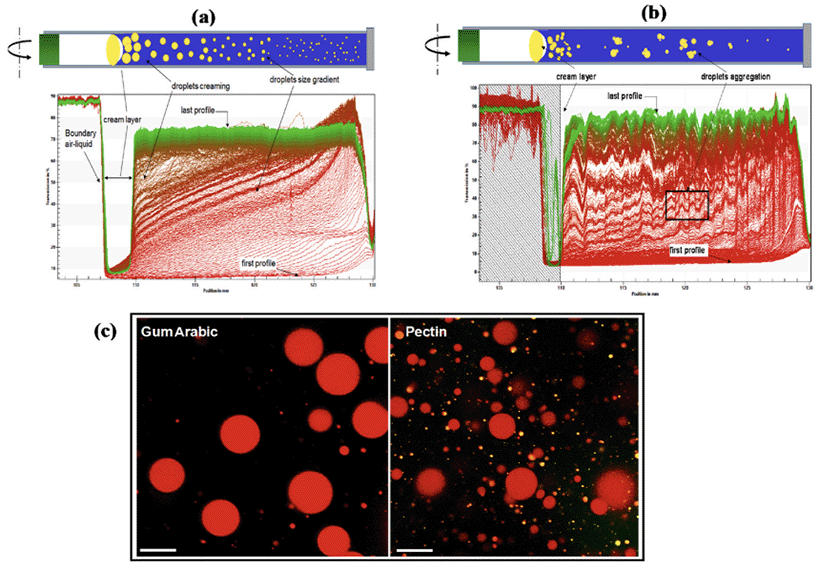
Fig. 3. Transmission profiles of curcumin-loaded nanoemulsions stabilized
with (a) 3% gum Arabic, and (b) 2% pectin; and (c) microstructure
of nanoemulsion droplets after oil labelling with Nile Red, insert bar is one μm. All nanoemulsions were produced with homogenization pressure of 100 MPa,
4 passes. (For interpretation of the references to colour in this figure legend, the reader is referred to the Web version of this article
그림과 같이 (a) gum arabic를 유화제로 한 nanoemulsion샘플의 transmission profile 은 시종 완만한 기울기로 이루어 진 그래프가 생성되었는데
이는 이 (a) gum arabic 유화제가 들어간 nanoemulsion 샘플은 매우 안정적이라는 것을 의미한다.
반면 (b) pectin을 유화제로 사용한 nanoemulsion샘플의 transmission profile 은 매우 불규칙적인 진동을 보이고 있다.
이러한 형태의 transmission profile 은 이 샘플 내부에서 droplet 이 서로 aggregation 하여 droplet 이 존재한다는 것을 의미하며 결국 이 nanoemulsion샘플은 안정성이 매우 떨어진다는 것을 의미한다.
laser confocal microscopy로 확인한 두 nanoemulsion샘플 droplet 의 microstrucure 역시 [그림 (c)] gum arabic 유화제를 사용한 nanoemulsion 의 droplet 크기는 매우 일정한데 반해
pectin 을 유화제로 사용한 nanoemulsion 의 droplet 은 aggregation 이 일어나 droplet 크기가 매우 다양하게 구성되어 있다는 것을 알 수 있었다. 이것은 그림 (a) 와 (b) 의 결과와 일치하였다.
Effect of other conditions
위와 같은 분석 방법으로 temperature, pH, salt concentration, freeze-thaw treatment 와 같은 다양한 조건에서 pectin 과 gum Arabic 을 유화제로 사용하는 curcumin (강황) nanoemulsion 의
안정성을 분석하였다.
Conclusions
미국 Microfluidics 사의 Microfluidizer 고압분산장비를 이용하여 식풀성 천연 유화제인 pectin 또는
gum Arabic 을 유화제로 첨가된 Curcumin Nanoemulsion (강황) 을 성공적으로 제조하였고
독일 LUM 사의 분산안정성 분석장비인 LUMiSizer Dispersion Analyser 를 이용하여 다양한
조건에서 어떤 유화제가 Curcumin Nanoemulsion 을 더 안정하게 유지시키는지 확인하였다.
|
|


